


Kemi Badenoch, symbol of a changing Conservative party and country
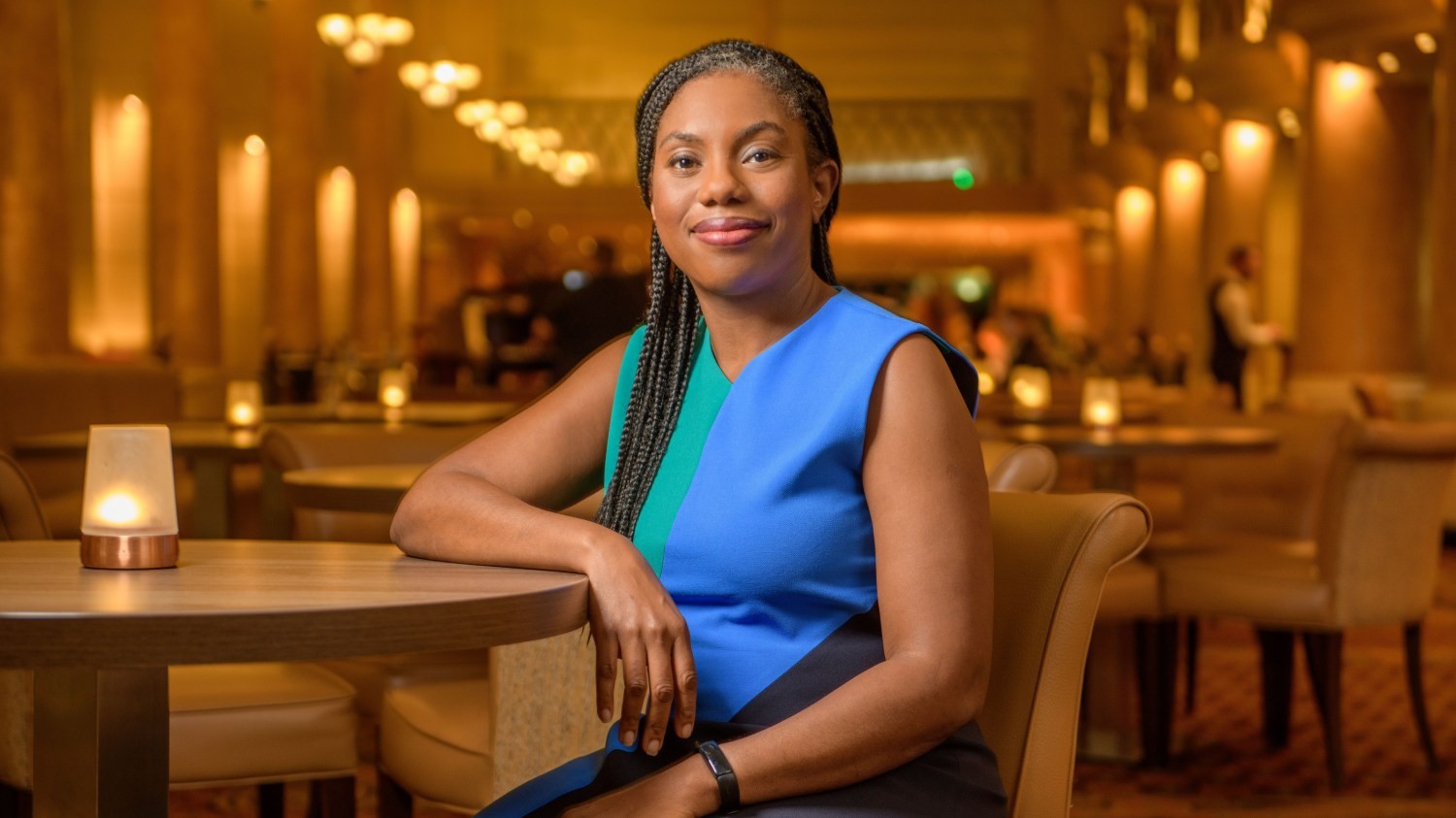
A sometimes tough upbringing in Nigeria helped give the new Tory leader the outsider status and combative personality that has helped her to reach the top of politics
Richard Assheton
She vows to “get down to business” and renew the Conservatives
Boris Johnson says she will bring “a much needed zing and zap” to the party
Sir Keir Starmer says her election is “a proud moment for our country”
JK Rowling is “delighted a woman who’ll stand up for sex-based rights is now leading the opposition”
If you had told John Taylor in 1992 that one day the Conservative Party would be led by a black, first-generation British-Nigerian immigrant, he would not have believed you.
Taylor — Lord Taylor of Warwick since being ennobled by John Major in 1996 — was the Conservatives’ first black borough councilor, and in the 1992 general election, its first black parliamentary candidate, for Cheltenham.
The campaign was marred by racism: constituency Tories rebelled against Taylor’s selection. One local member said there were too “few blacks in Cheltenham” to justify Taylor’s candidacy “and not a lot of coconuts either”.
While the Conservatives won nationally in 1992 with a record 14 million votes, Taylor lost in Cheltenham.
Thirty-two years later, history has not repeated itself. On Saturday the Conservatives elected Olukemi Olufunto Adegoke Badenoch as their leader to propel them to victory at the next general election.
Born in Wimbledon, southwest London in 1980, after her parents decided she should be born in Britain with the best private medical care they could afford, she spent much of her childhood in Lagos, Nigeria. Her parents did not realize at the time that their decision meant young Kemi had the right to a British passport.
“To all intents and purposes, I am a first-generation immigrant,” Kemi Badenoch said in her maiden speech in the Commons in 2017. Now she’s the first immigrant leader of a big western political party.
Badenoch’s triumph symbolises a remarkable shift in attitudes towards race in the Conservative Party, and Britain.
“We are a much more mobile and culturally diverse country today,” said Kwasi Kwarteng, a former cabinet colleague of Badenoch’s, and the first black chancellor of the exchequer, who was elected as an MP in 2010.
“Britain is a very different place from what it was in 1992,” said Taylor, reflecting on his Cheltenham defeat. Nigerians are the third-largest nationality group in the country: in 2021, 270,768 people in England and Wales stated Nigeria as their country of birth, making up 0.5 per cent of the population.
Taylor thought Badenoch would have struggled 20 years ago to get much traction against her defeated rival for the leadership, Robert Jenrick. But the country has changed.
Badenoch has repeatedly referred to her own story as the “British dream”. It’s the belief that anybody can come to the country and achieve success through talent and graft.
Outsider’s view
In 1992, as Taylor struggled in Cheltenham, Badenoch was enduring her own hardships. Her secondary school career began in 1991 with a spell at the Federal Government Girls’ College, Sagamu, a state-run boarding school in a rough town about 40 miles north of Lagos.
Her father, Femi Adegoke, was a doctor who ran his own clinic in the capital. Her mother, Feyi, was an academic. The Adegokes were an English-speaking couple who belonged to the Yoruba people, a west African ethnic group that makes up about a fifth of the population of Nigeria.
For most of the 1980s, the family — including Kemi and her two siblings — lived a comfortable middle-class life in Lagos. Such was their closeness, family friends likened their home to the set of The Cosby Show.
That comfort was shattered by Badenoch’s experiences at boarding school. “I had a very tough upbringing,” she told the Evening Standard in 2018. “We all had to do something called ‘manual labour’. Mostly it meant getting up at 5am and cutting grass endlessly. Everyone had their own machete.” Cutting the grass gave her blisters.
While Badenoch credits her father for her sense of personal responsibility, and her mother for inspiring her to go into politics, as a child she claims she had already begun to worship a British political icon.
“She talks about growing up as a little girl in Nigeria, which has a more misogynistic culture,” said a Badenoch ally. “Boys would say, ‘Why do you like maths and science, get back in the kitchen’ and Kemi would say, ‘Look at Margaret Thatcher — women can be strong and powerful too’.”
Nigeria’s fragile social peace began to disintegrate in the early 1990s. The economy crashed, and Femi’s business suffered while Feyi supported the family. The household often went without electricity. Badenoch later spoke of “fetching water in heavy, rusty buckets from a borehole a mile away” during this time.
In 1995, Nigeria was suspended from the Commonwealth after its military dictatorship executed prominent environmental activists. The Adegokes decided to get their 16-year-old daughter out of the country, using her British passport to send her to live with a family friend in Morden, south London.
Badenoch’s upbringing shaped her personality and her politics. One family friend told her biographer, Lord Ashcroft, that Kemi’s combative personality is the result of a “Nigerian approach to conflict resolution”.
She looks back at Nigeria’s instability in the 1990s as something that could happen to Britain one day. One of Badenoch’s favourite books is Why Nations Fail, by two economists who later won a Nobel prize. “One of the things that worries me is that we take this country for granted,” she said earlier this year.
As an immigrant in Britain, Badenoch was an outsider in the 1990s and early 2000s. She was surprised to see other teenagers at her London sixth-form college swearing and even more perturbed by the drug-taking she observed at the University of Sussex as a computer systems engineering student.
Her experiences of the British education system left her with a suspicion of what she once called “stupid lefty white kids”. That sense of shocked anger has never really left her.
A thread that runs through her politics is a puzzlement that some British people talk down their heritage and their country. As an immigrant to the country, she knows she is lucky to be here.
Badenoch’s outsider stance continues to inform her analysis of Britain’s strengths and weaknesses. Britain is not so special that it cannot end up like the dysfunctional Nigeria of her youth. “I don’t think that things are as bad as others do, but I do think we are on the cusp,” she said in a speech last year. “There is an inflexion point coming and we need to be very focused.”
In 2005, when she was 25, Badenoch toyed with the idea of returning to Nigeria to begin a political career there.
Her lifelong friend Taiwo Togun said Badenoch described meeting a Nigerian political figure who belittled her. They said “something about her being a woman and how she would never make it”.
Badenoch returned to Britain and joined the Conservative Party. By 2010 she was selected as a candidate for Dulwich & West Norwood, facing off against Tessa Jowell. Badenoch, then 30, finished third, and told an interviewer that she “hated identity politics”. Long before the phrase was part of the national conversation, Badenoch identified it as her enemy.
She met Hamish Badenoch in this south London Tory milieu in 2009. They got married at a Catholic church in Mayfair in 2012.
His upbringing could not have been more different from hers. Born into an upper middle-class Scottish-Irish family, Hamish Badenoch was a head boy at Ampleforth, went to Cambridge, and became a high- flyer at Deutsche Bank, where he still works.
“He provides wisdom, stability and loyalty,” said a friend of the couple, who have three young children. “He’s also an exceptionally good chef, who cooks haggis from scratch for their family Burns Night suppers. Hamish is an urbane and funny presence. His Toryism is plumb in the center.”
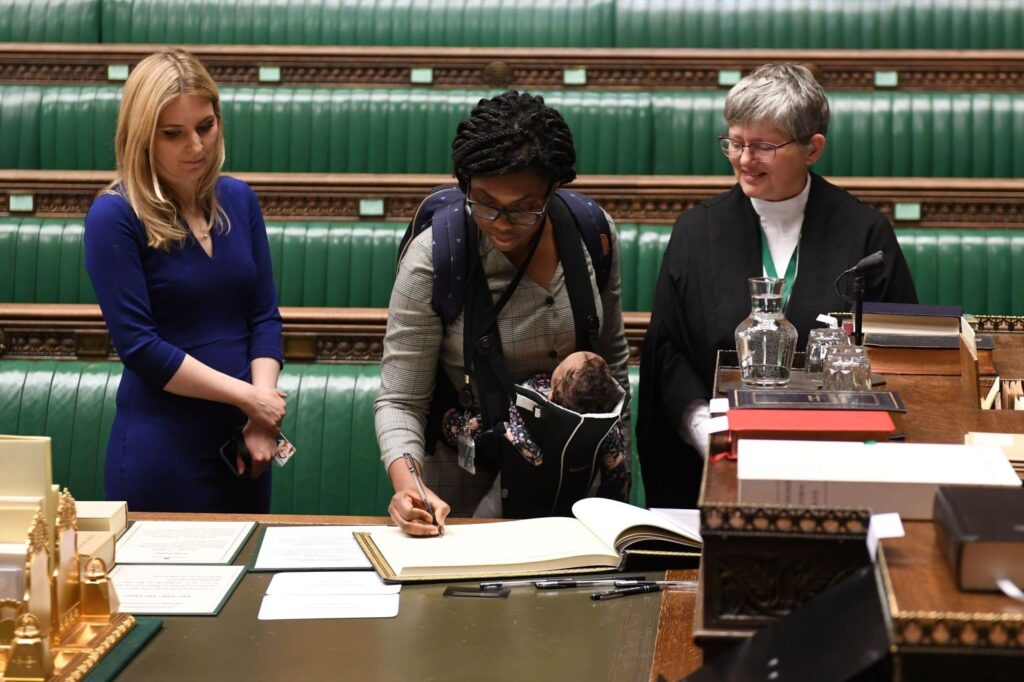
While she pursued a political career in her spare time, Badenoch worked as a software engineer at Logica, then moved to the Royal Bank of Scotland, Coutts and The Spectator magazine, where she was digital director from 2015 to 2016.
Her time at The Spectator confused some old colleagues there. “She was supposed to be in charge of tech. When we had tech problems, she would put them on a list and nothing would be done,” one recalls, calling her a “queen of dysfunction”. She would tell colleagues: “No one is more right-wing than me”.
But The Spectatordid help broaden Badenoch’s contacts in the upper crust of the Conservative Party. After voting for Brexit in 2016, she became the MP for Saffron Walden in Essex in 2017.
Stephen Parkinson was one of the candidates who competed with Badenoch for the selection. He recalls an intensely focused Badenoch listening to Eye of The Tiger and Simply the Best before giving a powerful speech to the local party members. “She wowed them,” said Parkinson, who voted for Badenoch to become leader this week.
She was the highest-profile MP of the 2017 intake. “I was impressed with her from the start,” said a former cabinet minister under Theresa May. “What really struck me was that she always knew her own mind”.
Kemi Badenoch, Theresa May and Hamish Badenoch
Kwarteng likewise viewed his colleague as “determined” and “forceful” from the beginning of her parliamentary career.
Privately, Brexit came as a big shock to Badenoch. Not because she didn’t agree with the policy — she voted to Leave in the referendum — but an ally said, “she could not believe there had been no planning on how to make Brexit work”. For Badenoch, an engineer, planning always has to come before policy. During Boris Johnson’s ill-fated government, Badenoch became a junior minister, and a major-general in what was derisively described as his government’s “war on woke”. Between 2019 and 2022, she charged headlong into contentious battles over race and gender identity.
With her anti-woke views, “Kemi is really not different from the average Nigerian”, said Cheta Nwanze, boss of the Lagos think tank SBM Intelligence, who has mutual friends with Badenoch.
In the wake of the Black Lives Matter protest that followed the death of George Floyd in the US in 2020, the Johnson government announced a Commission on Race and Ethnic Disparities, headed by the educationalist Lord Sewell of Sanderstead.
When the commission released its finding in May 2021, all hell broke loose. On social media, Sewell was compared to Joseph Goebbels, Hitler’s propaganda chief.
“Kemi was my praetorian guard,” said Sewell, remembering the uproar. “She was basically a one-woman army, and went in as a gladiator and took them all on.”
When Johnson’s government collapsed in June 2022, Badenoch was one of many ministers who resigned to pressure him out of No 10.
“None of that was about lockdown parties which she thought were ludicrously overblown by the media,” said the Badenoch ally. “But she knew the truth about Chris Pincher [who was accused of groping] and she found it unconscionable that ministers were sent out to lie about that incident.”
Badenoch then began a tilt at the leadership, backed by Michael Gove. She made it to the fourth round, securing the support of 59 MPs. She later served as a minister under both Liz Truss and Rishi Sunak.
She kept a picture of a quote from the conservative philosopher Sir Roger Scruton in her office: “Good things are easily destroyed but not easily created.” The line was shorthand for her political outlook. Badenoch once described her job as “to kill bad ideas”. How she killed those ideas could upset her political adversaries.
One former cabinet minister, on the receiving end of a typically frank remark, remembered Banenoch explaining it away as a “Nigerian thing”. “Well, we are not in Nigeria,” the cabinet minister thought. (The Badenoch ally said she doesn’t do “high-effort courtesy”.)
Stories about Badenoch’s brusqueness, poor time-keeping and laziness began to leak into the press. “People say she’s lazy,” said Kwarteng. “But you’re not growing up in Nigeria in the 1980s and then rising to become the leader of the Conservative Party if you’re lazy.”
Earlier this summer, Badenoch gathered her circle of advisers to begin planning her campaign for the party leadership. One of them began canvassing prospective Tory MPs during the general election, when Sunak was still leading the party. Badenoch wanted to know that she would be able to reach the final two in any race.e
Badenoch started her campaign on September 2. While the former immigration minister Robert Jenrick, her main rival, made policy the centrepiece of his campaign, making a high-profile promise to leave the European Convention on Human Rights, Badenoch instead focused on a more wide-ranging project called Renewal 2030, emphasizing that Tories need to rediscover their principles before obsessing over policy.
Fuelled by popcorn, Bounty bars, sugary tea and Coke Zero (“It can’t be cold,” said a colleague, “it has to be room-temperature”), Badenoch wrote her own speeches and opinion pieces during the campaign. While she is not believed to have offered shadow cabinet positions to any of the MPs who backed her, Badenoch, like Jenrick, is believed to have offered the position of deputy leader to Lord Houchen of High Leven, the Teesside mayor.
Badenoch’s team sensed she had sealed the deal on October 17, when she went head-to-head with Jenrick in a televised debate in Westminster on GB News. Two full days of detailed preparations paid off. “That was 100 per cent Kemi,” said the colleague, “Thoughtful, intelligent, funny, charming. She swept the audience in the room. My phone was lighting up afterwards.”
Being the leader of the opposition is a far from enviable job. William Hague referred to his four years facing Tony Blair between 1997 and 2001 as “the night shift”.
“There has to be a slow, painstaking process of rebuilding intellectual credibility”, said Gove, now editing The Spectator, which backed neither candidate in the race, “before a public exasperated with Labour can sufficiently believe in the Tories once again.”
The Liberal Democrats are already gearing up to attack Badenoch with a suite of digital ads and leaflets in “blue wall” seats that the Conservatives will need to win back to form a governing majority in 2029.
While Badenoch attempts a difficult triangulation between Labour, Reform and Lib Dem voters, she will have to keep her own party in check. One former cabinet minister predicts that “civil war” could break out in the party at any time. “She’s not popular among MPs” said one Tory backbencher. “They do worry that she could blow up at any time, and it’s not a stupid worry.”
“There’s a contradiction there. She’s the person who rejects left-wing ideology, but also plays the same kind of game herself with identity politics.”
For the moment, one 71-year-old peer will be content to bask in the symbolism of Badenoch’s win. “The British people are quite middle of the road. This is the country of Shakespeare, but it is also a country where a Nigerian can become the leader of the opposition,” said Taylor. “That is what makes our country great.”
| Editado por los Papeles del CREM, 3 de noviembre del año 2024. Responsable de la edición: Raúl Ochoa Cuenca. [email protected]
|